The best time to visit Vík
Vík is open for visitors all year, and most tours run in every month. What changes is the light, from four and a half hours of sun at midwinter to nights that never get properly dark in June, and which places and trails you can reach.

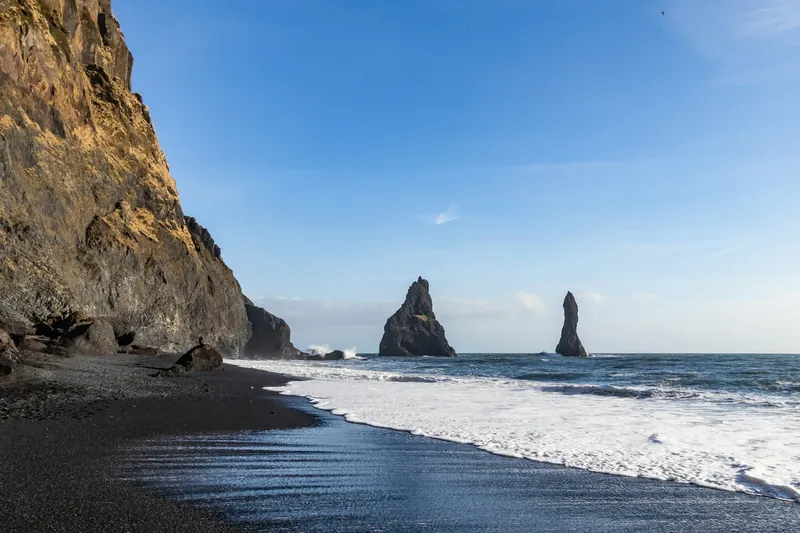
There is no closed season in Vík. The beach at Reynisfjara, the village and the main tours are there in every month, and the Icelandic Met Office explains why the winters are gentler than the latitude suggests: a branch of the Gulf Stream runs along the south and west coasts and moderates the climate. The same sea brings a lot of rain. So the question is less about temperature and more about daylight, wind and which roads and paths are open.
Light through the year
Vík lies at about 63.4° north, well south of the Arctic Circle, so it has neither midnight sun nor polar night. The sun times below are for a flat horizon; the mountain Reynisfjall and the slopes behind the village can hide the low winter sun for longer.
| Date | Sunrise | Sunset | Daylight |
|---|---|---|---|
| 21 December | 10:59 | 15:29 | 4 h 30 |
| 1 February | 9:52 | 17:08 | 7 h 16 |
| 21 March | 7:14 | 19:34 | 12 h 20 |
| 1 May | 4:54 | 21:34 | 16 h 40 |
| 21 June | 3:00 | 23:35 | 20 h 35 |
| 1 August | 4:29 | 22:13 | 17 h 44 |
| 21 September | 6:56 | 19:21 | 12 h 25 |
| 1 November | 8:55 | 17:03 | 8 h 08 |
All times are in UTC. Through June the sky stays brighter than civil twilight all night, even though the sun dips below the horizon for about three and a half hours.
Weather and rain
Vík is one of the wettest places in Iceland. Our own average of the Met Office station data for 1991 to 2000 comes to roughly 2,400 mm a year, with every month between about 150 and 250 mm. September and October were the wettest months on average, April to July the driest. Temperatures stay in a narrow band: about 1 to 2 °C on average from December to March and about 11 °C in July and August. No month averaged below freezing in that period, but single cold snaps happen; the lowest reading in the station's monthly data from 1961 to 2013 was −16.9 °C, in April 1968, and the highest 24.4 °C, in August 2004. For the practical side, see what to wear.
Winter, November to February
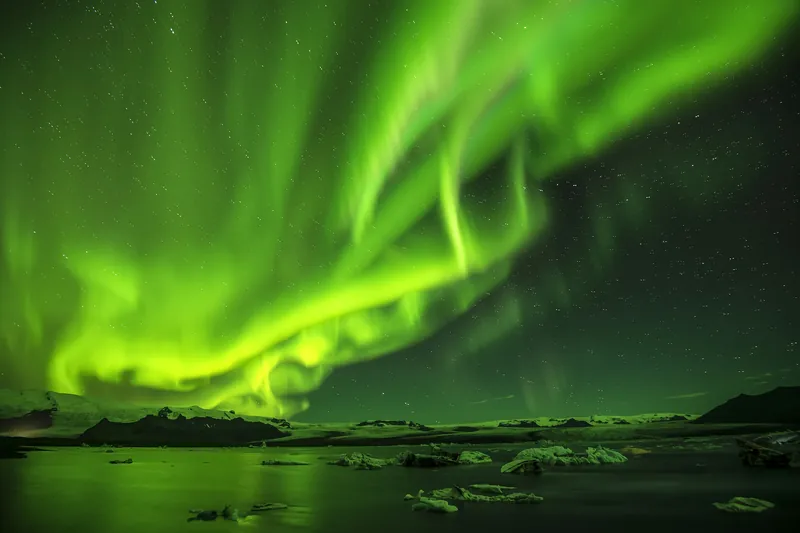
Short days set the pace. With sunrise around 11:00 at midwinter, a glacier walk or ice cave tour in the late morning and one stop on the coast in the afternoon is a realistic day. Ice cave tours to Katla run in winter as in summer, and the cave can look different from week to week. The upper road to the lighthouse at Dyrhólaey is often closed entirely in winter because of ice and wind. Snow or ice on Route 1 is possible, so look at umferdin.is or call 1777, the road information line. For indoor hours, the Skógar museum stays open from 10:00 to 17:00 through the winter, and the Katla centre in Vík has a free exhibition on the volcano and the geopark. The long nights are the time for northern lights, covered on our northern lights page.
Spring, March to May
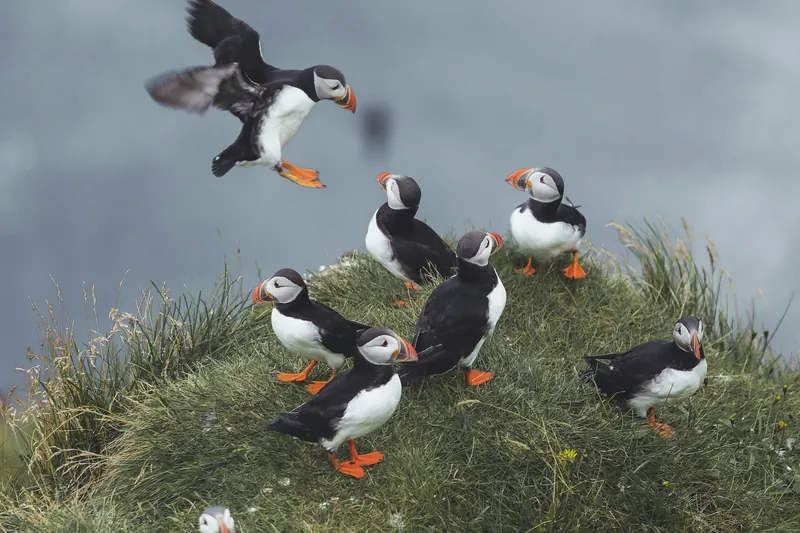
Daylight grows fast, from about ten hours on 1 March to more than sixteen by 1 May. The puffins return to the cliffs at Dyrhólaey in late April. From about mid-May the nesting season begins, and parts of the reserve close or open only from 9:00 to 19:00, with the upper area at the lighthouse closed at night; the legal window for such limits runs from 1 May to 25 June. The first summer-only trips start again: the canyon tour to Þakgil and Remundargil runs from May to October, weather permitting.
Summer, June to August
This is the season of long evenings and open highland routes. The Fimmvörðuháls trail from Skógar is usually open from about 25 June to 15 September, and the summer Highland Bus links Reykjavík with Skógar and Þórsmörk from June to September. The Skógar museum keeps longer hours from June to August, 9:00 to 18:00. The puffins stay until about mid-August. In the ice caves, reviews from summer often describe a smaller cave with melting ice.
Autumn, September and October
September still has about twelve to fourteen hours of daylight, and the dark nights return, so northern lights become possible again. September and October were also the wettest months in the station data. The Fimmvörðuháls season ends in mid-September and the Highland Bus stops running towards the end of the month, while the Þakgil canyon tour continues to the end of October.
On a day of heavy rain, the Lava Show in the village runs in any weather and lasts about 50 minutes. Our itineraries suggest how to arrange a stay of one to three days around the light.
All tours side by side
A few tours whose timing depends on the season: a canyon trip that only runs from May to October, a buggy ride with a winter route, an ice cave tour that runs through the year and an indoor show for any weather.
| Tour | Format | Duration | Age | Rating | From |
|---|---|---|---|---|---|
| Katla ice cave across MýrdalssandurArctic AdventuresA high-clearance Super Jeep crosses the Mýrdalssandur plains to the edge of the Katla glacier, followed by a beginner-level walk on the ice into the cave. | Super Jeep and glacier walkSuper Jeep from Vík, crampons, helmet | 3 hours from Vík (12 hours from Reykjavík)Icewear/Krónan car park in Vík, or Reykjavík option | From 6 years | 4.6 (2,633 reviews) | From €168Free cancellationBook on GetYourGuide |
| Lava Show ticket in VíkLava ShowReal lava heated to 1,100 °C is poured a few metres from the audience while a presenter explains Iceland's eruptions, in English. | Indoor showEntrance ticket | 50 minutesLava Show, Vík | All ages | 4.7 (1,281 reviews) | From €49Free cancellationBook on GetYourGuide |
| Two-seater buggy towards MýrdalsjökullIcelandic Mountain GuidesTwo people share a buggy and swap at the wheel; in winter the route can switch to the black sand beach and the plane wreck. | Buggy, shared or singleOverall, helmet, balaclava, tea and coffee | 2 hours (10 hours from Reykjavík)Ytri-Sólheimar base in Mýrdalur, or Reykjavík transfer | From 6 years; drivers need a licence | 4.7 (33 reviews) | From €254Free cancellationBook on GetYourGuide |
| Þakgil canyon and Remundargil fallsGravel TravelFrom May to October, a day with the Konnahammer lookout, a cave, the Remundargil waterfall and a hike through the Þakgil canyon. | Jeep day trip with hikeGuided stops, drive back to Vík | 9 hoursVík, ends at the Icewear centre | – | – | From €1222Free cancellationBook on GetYourGuide |
Prices and ratings come from the booking platform and are shown in euros per person. If you book through these links we earn a commission. Your price stays the same. Sorted by number of reviews.
Questions travellers ask
What is the best month to visit Vík?
It depends on what you want. June and July bring the longest days and access to the highland trails, late April to mid-August the puffins, and the darker months from September to April the chance of northern lights. Ice cave tours run in winter and summer.
How many hours of daylight are there in December?
On 21 December the sun rises at 10:59 and sets at 15:29, about four and a half hours over a flat horizon. Civil twilight adds a little over an hour at each end.
How cold is Vík in winter?
Mild for Iceland: from December to March the monthly average was about 1 to 2 °C, and no month averaged below 0 °C in the period we looked at. Snow and ice on the roads still happen, so check umferdin.is or call 1777 before you drive.
When can I see puffins near Vík?
Visit South Iceland gives late April to mid-August for the puffins nesting in the cliffs at Dyrhólaey. Parts of the reserve close or only open during the day from about mid-May to late June while the birds breed.
Are ice caves open in summer?
The Katla ice cave tours run all year. The cave changes from week to week, and in summer reviewers often describe it as small and melting, so expect a shorter look inside than in winter photos.
Where these facts come from
Dates, opening hours and rules change. We checked these pages in October 2026; the official source has the final word.
- US Naval Observatory: Sun and moon data for Vík
- Icelandic Met Office: monthly averages, station 798 Vík í Mýrdal
- Icelandic Met Office: Climate in Iceland
- Icelandic Met Office: Aurora forecast
- Visit South Iceland: Visiting Dyrhólaey, what to know before you go
- Environment Agency of Iceland: Dyrhólaey, access and management
- Ferðafélag Íslands: Fimmvörðuháls
- Skógasafn: Opening hours and bookings
- Icelandia: Highland Bus
- Umferdin: road conditions
- Tour pages on GetYourGuide and Viator, checked 23 October 2026