
What to wear in Vík
Vík is mild for Iceland but very wet, with roughly 2,400 mm of rain and snow a year. Waterproofs are the one thing you need in every season, and the tours lend you the specialist gear for ice, quads and kayaks.

Vík is one of the wettest places in Iceland. Our average of the Met Office data for 1991 to 2000 comes to roughly 2,400 mm a year, and no month had less than about 150 mm. Temperatures, on the other hand, stay moderate: about 1 to 2 °C on average from December to March and about 11 °C in July and August. That combination decides what to pack. You rarely need heavy Arctic clothing here, but you will almost certainly get wet.
The basics for every season
A waterproof jacket with a hood and waterproof trousers are worth more than any single warm item. Under them, layers work better than one thick coat: a thermal base layer, a fleece or light down jacket, and something you can take off when you walk uphill. Pack a hat and gloves even in summer; at the glacier and on the beach the wind makes it feel colder than the thermometer suggests.
For your feet, take waterproof boots with a good grip. The paths to the glacier tongue, the plane wreck and the waterfalls are often wet, the black sand and pebbles at Reynisfjara get into everything, and close to Skógafoss the spray soaks you quickly. A spare pair of socks in the car is a good habit. At Reynisfjara, single waves can run far up the beach without warning, and the beach is divided into warning zones with a light signal; footwear you can move quickly in matters more there than looks. The Reynisfjara page explains the zones.
Winter
From November to March the monthly averages hover a little above freezing, but single cold spells happen; the lowest reading in the station's monthly data from 1961 to 2013 was −16.9 °C, in April 1968. Wind and wet snow are a bigger issue than the cold itself. Add a warmer mid-layer, a thicker hat and waterproof gloves, and keep a dry set of clothes in the car. Northern lights evenings mean standing still outside for a long time, so dress more warmly than for the day.
Summer
July and August are cool: the warmest July day in 1991 reached 21.2 °C, but most days stay well below that. A fleece and the waterproof shell cover most situations. If you plan to hike Fimmvörðuháls from Skógar, prepare for mountain weather even in July: the Icelandic Touring Association warns of fog, strong winds and sudden storms, and snow can lie on the pass well into summer.
What the tours provide
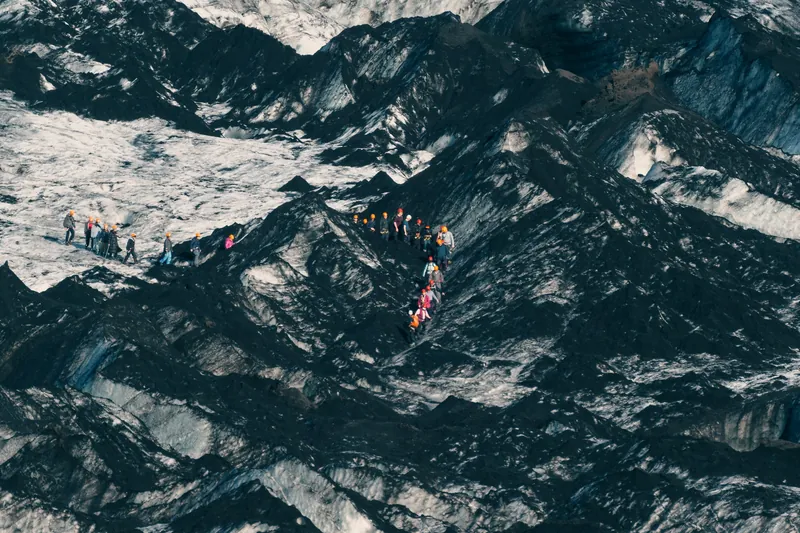
Much of the specialist gear comes with the tour, so you do not have to bring it from home. The details differ between operators, so read the inclusions before you book:
- Glacier walks include crampons, an ice axe, a helmet and a harness. Hiking boots can be rented at the meeting point, and at one base camp rain gear as well. One operator's crampons fit shoe sizes 35 to 50 EU, and another warns that rain makes the walk more demanding.
- Ice cave tours lend helmets and crampons, and the FastTrack tour adds headlamps. At least one says gloves and headwear are not included.
- The quad and buggy rides hand out an insulated overall, a helmet and a balaclava, and boots depending on the weather.
- The kayak trip on the glacier lagoon puts you in a drysuit. Warm clothing to wear underneath and an extra pair of socks are your part.
- The zipline tour includes a hike of two to three kilometres, and hiking boots are not provided.
- For riding on the beach, the stable lends a helmet, but not shoes.
Indoors, the Lava Show is the exception: the organisers recommend breathable clothing, because real lava at about 1,100 °C is poured just metres from the audience.
Riding clothes and import rules
Iceland's horses are protected by strict import rules from the food and veterinary authority MAST. Used saddles, bridles, whips and other tack, and used riding gloves, may not be brought into the country. Used riding clothes and boots must be machine-washed or dry-cleaned before you travel. Anything that cannot be washed, helmets included, has to be cleaned, dried, sprayed with a 2 % Virkon S solution and stored for at least five days before it comes into contact with Icelandic horses. The simplest option is to use the helmet the stable provides. See our horse riding page for the rides around Vík, and the best time to visit for how the weather changes through the year.
Questions travellers ask
Do I need hiking boots for a glacier walk?
You need sturdy shoes that the crampons can be strapped to. The glacier operators rent hiking boots at the meeting point, and one notes that its crampons fit shoe sizes 35 to 50 EU.
What should I wear in an ice cave?
Warm, waterproof layers, gloves and a hat. The ice cave tours lend helmets and crampons, and some add headlamps, but at least one says gloves and headwear are not included.
Is it cold in Vík in summer?
It is cool rather than cold. July and August averaged about 11 °C in the station data we used, with single warm days above 20 °C, but rain and wind are common, so bring a fleece and a waterproof shell.
Can I bring my own riding clothes?
Yes, if they are clean. Used riding clothes and boots must be machine-washed or dry-cleaned before you travel. Used riding gloves, saddles and bridles may not be imported at all.
What do I need for the Lava Show?
Nothing special. The organisers recommend breathable clothing, since lava heated to about 1,100 °C is poured a few metres in front of you.
Where these facts come from
Dates, opening hours and rules change. We checked these pages in October 2026; the official source has the final word.

