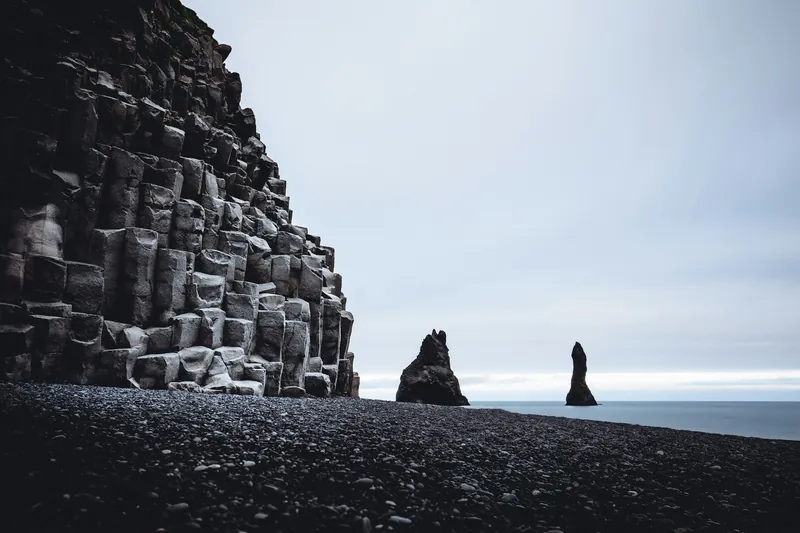
Northern lights around Vík
From about September to April the nights around Vík are dark enough for the aurora. Seeing it depends on solar activity and, on this rainy coast above all, on a gap in the clouds. No one can guarantee a sighting.
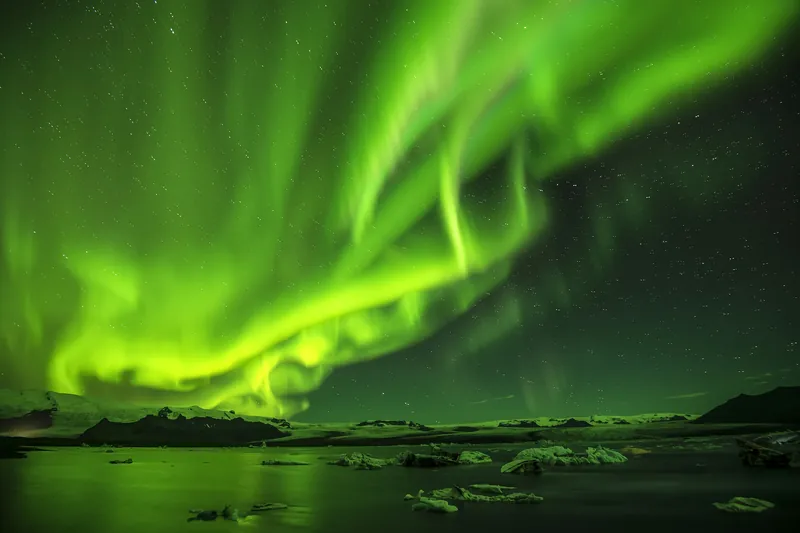
The Icelandic Met Office sums up the conditions in one line: the aurora needs dark and at least partly clear skies. Darkness is easy to plan around Vík. Clear sky is the hard part, because this is one of the wettest corners of Iceland, with roughly 2,400 mm of rain and snow a year in the station data we averaged. So treat the northern lights as something that may happen on a winter evening, not as the reason for a single night's stay.
When it gets dark
Vík lies at about 63.4° north, south of the Arctic Circle. From about early May to early August the sky never gets properly dark: even on 1 August, civil twilight ends only at 23:34 and starts again at 3:07. That leaves a usable season of roughly September to April. The times below, from the US Naval Observatory, show when civil twilight ends in the evening and begins in the morning, which is about when the sky is dark enough to look:
| Date | Dark from | Dark until |
|---|---|---|
| 1 September | 21:22 | 5:08 |
| 1 October | 19:33 | 6:37 |
| 1 November | 17:55 | 8:03 |
| 1 December | 16:51 | 9:18 |
| 1 January | 16:54 | 9:45 |
| 1 February | 18:03 | 8:57 |
| 1 March | 19:22 | 7:36 |
| 1 April | 20:54 | 5:48 |
The morning time is the next morning, give or take a minute or two. All times are in UTC. Real darkness, after astronomical twilight, comes somewhat later in the evening than the table shows.
The difference between the ends of the season is large. On 1 December the sky is dark for about sixteen and a half hours, so you can look in the early evening and still get a full night's sleep. On 1 September it is under eight hours, and the window starts after 21:00. In March and April the evenings are still dark from about 19:30 or 21:00, and the weather tends to be no wetter than in autumn: in the station data, September and October were the wettest months of the year.
Reading the forecast
The Met Office publishes an aurora forecast with two parts. One is an activity value for midnight on a scale from 0 to 9. The other is a cloud map, on which green areas are cloudy and white areas are clear. On the south coast the cloud map usually matters more: a moderate activity value under a clear sky beats a high value under solid cloud. The sunrise and moonrise times on that page are for Reykjavík, so use the table above for Vík.
Check the map in the late afternoon and again after dark, because the cloud picture changes during the evening. If the area around Vík is covered, a short drive along Route 1 may bring you under a clear patch, but only drive when the roads are fine: look at umferdin.is or call 1777, the road information line.
Where to watch
Street lights wash out faint aurora, so move a little away from the village. You do not need a famous viewpoint; a safe place to park with a dark view to the north is enough. A few things to keep in mind on this particular coast:
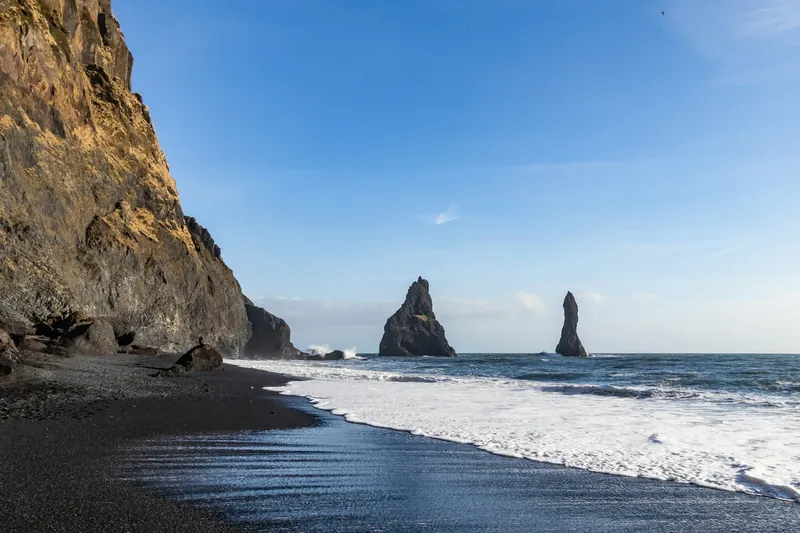
- Reynisfjara is not a place to wander at night. The waves have killed several visitors, single waves run far up the beach without warning, and in the dark you cannot see them. If you go, stay high on the beach crest, behind the warning signs, and never walk down to the water.
- At Dyrhólaey the upper road to the lighthouse is often closed entirely in winter because of ice and wind, and the cliff edges are dangerous in the dark.
- Never stop on Route 1 itself to take photos. Use a car park or a proper lay-by and switch off your headlights only once you are off the road.
Clothing and an evening plan
Winter averages in Vík are only a little above freezing, about 1 to 2 °C from December to March, but standing still outside at night in wind feels much colder. Bring a warm hat, gloves, a thick mid-layer and your waterproofs, and a flask if you plan to wait. Our clothing guide has the details.
On a cloudy evening there are indoor alternatives in the village, such as the Lava Show, which lasts about 50 minutes. If you are out late in winter, tell someone your plan or leave it with Safetravel; the emergency number is 112. For the rest of the season, see the best time to visit Vík.
Questions travellers ask
Can you see the northern lights in Vík?
Yes, on clear, dark nights from about September to April, when solar activity is high enough. The aurora is never guaranteed, and Vík gets a lot of cloud and rain, so plan several evenings rather than one.
What is the best month for northern lights in Vík?
Any month from September to April can work. The darkest nights are in December and January, when the sky is dark from before 17:00, while September, March and April have milder evenings and darkness from about 19:30 to 21:30.
How do I read the aurora forecast?
The Icelandic Met Office shows aurora activity for midnight on a scale from 0 to 9 and a cloud cover map, on which green areas are cloudy and white areas clear. Look for a white patch near you rather than for a high number alone.
Are there northern lights tours from Vík?
None of the tours we compare is a northern lights trip from Vík, so you look on your own. The road, a parked car away from the village lights and the forecast are all you need.
Is it safe to watch the aurora from Reynisfjara?
Only from well back on the beach crest. The waves at Reynisfjara are unpredictable, and at night you cannot see them coming. Stay behind the warning sign and never walk down to the water in the dark.
Where these facts come from
Dates, opening hours and rules change. We checked these pages in October 2026; the official source has the final word.
- Icelandic Met Office: Aurora forecast
- US Naval Observatory: Sun and moon data for Vík
- Icelandic Met Office: monthly averages, station 798 Vík í Mýrdal
- Icelandic Tourist Board: new signs at Reynisfjara
- Visit South Iceland: Reynisfjara, Reynisfjall and Reynisdrangar
- Visit South Iceland: Visiting Dyrhólaey
- Vegagerðin: Traffic service 1777
- Safetravel (ICE-SAR)